The Trail History and Civics for Class 7 ICSE Solutions – Directive Principles of State Policy

The Trail History and Civics for Class 7 ICSE Solutions – Directive Principles of State Policy

ICSE SolutionsSelina ICSE SolutionsML Aggarwal Solutions

Trail HistoryCivics Focus on HistoryCivicsGeographyMathsPhysicsChemistryBiology

EXERCISE

A. Fill in the blanks :

  1. The guidelines which all govemments are expected to follow for the welfare of the people are known as Directive Principles of State Policy.
  2. The Directive Principles contain a list of important and basic economic and social rights which the farmers of the Constitution wanted every Indian to enjoy.
  3. To establish economic equality in the country, the government is directed to ensure a fair and equal distribution of the wealth and material resources of the country.
  4. The government is directed to promote cottage industries in villages and prohibit the slaughter of cows and other cattle according to the Gandhian principles.
  5. Free and compulsory education for all children between 6 r and 14 years has been made a Fundamental Right.

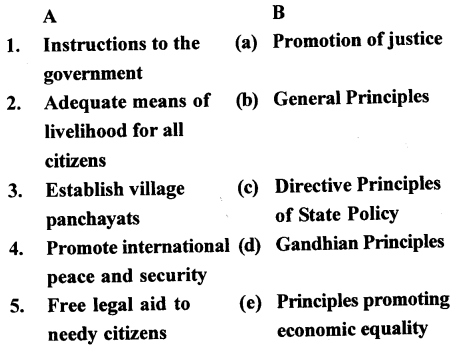
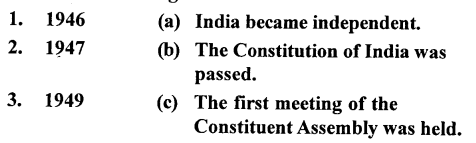
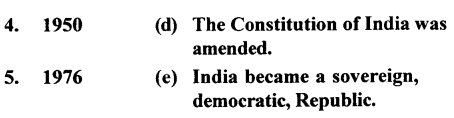
B. Match the following :
The Trail History and Civics for Class 7 ICSE Solutions Chapter 13 Directive Principles of State Policy 1
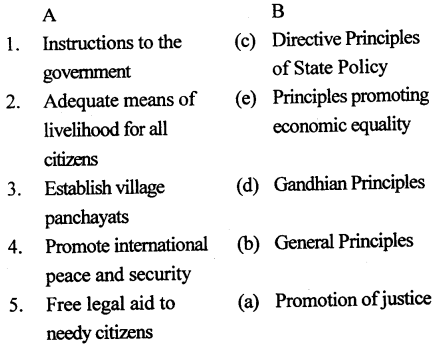
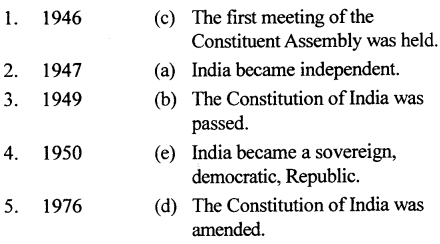
Answer:
The Trail History and Civics for Class 7 ICSE Solutions Chapter 13 Directive Principles of State Policy 2

C. Choose the correct answer :

1. After 200 years of foreign rule, the Indian economy was strong/stable/ruined.
Ans. After 200 years of foreign rule, the Indian economy was ruined.

2. The Directive Principles can be classified into three/ four/five categories.
Ans. The Directive Principles can be classified into three categories.

3. Some of the ideas of B. R. Ambedkar/Jawaharlai Nehru/Mahatma Gandhi were included as Directive Principles.
Ans. Some of the ideas of Mahatma Gandhi were included as Directive Principles.

4. One of the Gandhian Principles/General Principles/ Principles promoting economic equality directs the government to prevent the consumption of liquor.
Ans. One of the Gandhian Principles directs the government to prevent the consumption of liquor.

5. The Directive Principles ask the government to provide free legal aid/economic help/housing.
Ans. The Directive Principles ask the government to provide free legal aid.

D. State whether the following are true or false :

1. The farmers of our Constitution had a dream of a welfare state.
Ans. True.

2. The provision of free and compulsory education to all children up to the age of 14 is a General Principle.
Ans. False.

3. The Fundamental Rights and Directive Principles of State Policy do not have the same purpose.
Ans. False

4. If you are deprived of your Fundamental Rights, you can go to the High Court or the Supreme Court to seek protection and enforcement of your rights.
Ans. True.

5. India has achieved the goal of a Welfare State.
Ans. False.

E. Answer the following questions in one or two words/ sentences :

Question 1.
Define a welfare state?
Answer:
Welfare State is a country where citizens are guaranted a healthy standard of living, equal opportunities, full employment, fair distribution of wealth and they also enjoy social and economic justice.

Question 2.
What are Directive Principles of State Policy?
Answer:
In the Constitution there are certain guidelines which the central, state and local governments are expected to follow while making and implementing policies and programmes for the welfare of the people, these guidelines are known as Directive Principles of State Policy.

Question 3.
Mention the categories into which Directive Principles can be classified.
Answer:
Directive Principles can be broadly classified into three categories:

  1. Principles promoting economic equality
  2. Gandhian Principles promoting economic and social development
  3. General Principles.

Question 4.
Mention any one Directive Principle that seeks to promote economic equality between men and women.
Answer:

  1. There should be a fair and equal distribution of wealth and material resources of the country.
  2. There should be equal pay for equal work, for both men and women.

Question 5.
What is the significance of the Right to Education Act of 2009?
Answer:
The Right to Education Act of 2009 (Article 21A of the Constitution) makes education a Fundamental Right of every Indian child between the ages of 6 and 14 years. It requires all privately owned schools to reserve 25 per cent of seats for children from poor families.

Question 6.
Why can you not seek justice in a court of law if the government does not give you a job?
Answer:
Directive Principles, on the other hand, are non-justiciable, i.e. if you do not get a job or proper wages, you cannot go to a court to seek justice.

F. Answer the following questions briefly :

Question 1.
Why did the farmers of the Constitution not establish a welfare state in India in 1949? What steps did they take to help future governments to achieve the goal of a welfare state?
Answer:
The farmers of our Constitution had a dream of a welfare state. A welfare state is a country where citizens are guaranteed a healthy standard of living, equal opportunities, full employment and a fair distribution of wealth.
The fanners of the Constitution, however, could not fulfil this dream in 1949. Our country had just been freed from 200 years of foreign rule which had ruined India’s economy. So they laid down certain guidelines in the Constitution for all future governments to follow.

Question 2.
State one Directive Principle with regard to each of the following :

(a) wealth and material resources
(b) weaker sections of society
(c) foreign affairs.

Answer:
(a) Wealth and material resources : Fair and equitable distribution of wealth and material resources of the country. The resources of the country should be used for the common good of all.
(b) Weaker sections of society : A living wage for every worker, i. e., a wage which will enable a person to buy basic necessities.

(c) Foreign policy :

  1. Promote international peace and security.
  2. Maintain just and honourable relations with other countries.

Question 3.
Mention two Directive Principles with reference to each of the following :

(a) Development of villages
(b) Health

Answer:
(a) Development of villages :

  1. Establish village panchayats.
  2. Modernize agriculture and animal husbandry.

(b) Health :

  1. Improve the level of nutrition and general health of the people.
  2. Prevent consumption of liquor and other harmful drugs.

Question 4.
Mention the category under which the following principles are classified :

(a) a decent standard of living and leisure
(b) prevention of the slaughter of cows and other cattle
(c) protection of the environment.

Answer:

(a) Economic equality.
(b) Gandhian Principles.
(c) General Principles.

Question 5.
Compare and contrast the Fundamental Rights and Directive Principles of State Policy.
Answer:
Fundamental Rights are justiciable, i.e., – if people are deprived of their Fundamental Rights, they can go to the Court to seek protection and enforcement of their rights. Directive Principles, on the other hand, are non justiciable, i.e., – if you do not get a job or proper wages you cannot go to a court to seek justice.

Question 6.
Briefly discuss the efforts made by various governments to implement the Directive Principles of State Policy.
Answer:
Various steps have been taken by all governments to implement Directive Principles like-free and compulsory education is provided to all the children between six to fourteen years. Welfare schemes for the Scheduled castes and Scheduled tribes are implemented. Various employment schemes have been launched and a law is passed which guarantees equal pay for both men and women.

G Picture study :
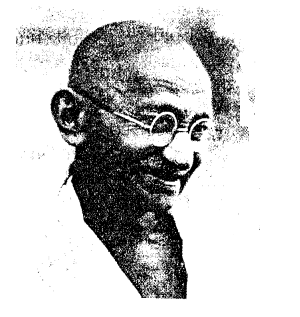
This is the picture of the Father of our Nation, who championed the cause of the poor and downtrodden people in India.

The Trail History and Civics for Class 7 ICSE Solutions Chapter 13 Directive Principles of State Policy 3

Question 1.
Identify the person in the picture.
Answer:
Father of our nation Mahatma Gandhi

Question 2.
Mention any two of his ideas that were included in the Directive Principles of State Policy.
Answer:

(a) Provide free and compulsory educations for all children up to the age of 14.
(b) Promote cottage industries in villages.

Question 3.
What does the term Directive Principles of State Policy mean?
Answer:
Directive Principles of State Policy are guidelines which all government are expected to follow while and programmes for the welfare of the people.

Question 4.
Mention one important difference between Fundamental Rights and Directive Principles.
Answer:
An important difference between them is that the Fundamental Rights are justiciable, i.e., if people are deprived of their Fundamental Rights, they can go to the Court to seek protection and enforcement of their rights. Directive Principles, on the other hand, are non-justiciable, i.e., if you do not get a job or proper wages, you cannot go to a court to seek justice.

OTHER IMPORTANT QUESTIONS

Question 1.
Mention two Directive Principles with reference to Standard of living of citizens?
Answer:
The Directive Principles related to standard of living are :

(a) There should be an adequate means of livelihood for all its citizens.
(b) It is important to ensure that every citizen enjoys a decent standard of living and leisure.

Question 2.
Explain briefly what is Gandhian Principles?
Answer:
During the freedom movement, Gandhiji had worked out a plan for social development. Some of his ideas were included as Directive Principles, these are known as Gandhian Principles.

The Trail History and Civics for Class 7 ICSE Solutions – The Constitution and the Preamble

The Trail History and Civics for Class 7 ICSE Solutions – The Constitution and the Preamble

ICSE SolutionsSelina ICSE SolutionsML Aggarwal Solutions

Trail HistoryCivics Focus on HistoryCivicsGeographyMathsPhysicsChemistryBiology

EXERCISE

A. Fill in the blanks :

  1. The Constitution of India was framed by the constituent Assembly.
  2. The Preambles tells us about the source of the Constitution, the nature of the state and its main objectives of the Constitution.
  3. Socialism involves fair distribution of the country’s wealth among all sections of the people.
  4. The people of India elect their own government because India is a Democratic country.
  5. The President of India has a fixed term of 5 years.

B. Match the following :
The Trail History and Civics for Class 7 ICSE Solutions Chapter 12 The Constitution and the Preamble 1
The Trail History and Civics for Class 7 ICSE Solutions Chapter 12 The Constitution and the Preamble 2
Answer:
The Trail History and Civics for Class 7 ICSE Solutions Chapter 12 The Constitution and the Preamble 3

C. Choose the correct answer :

1. India won freedom from British/French/Portuguese rule on 15 August 1947.
Ans. India won freedom from British rule on 15 August 1947.

2. The chairman of the Constituent Assembly of India was Dr Rajendra Prasad/B. R. Ambedkar/Maulana Azad.
Ans. The chairman of the Constituent Assembly of India was Dr Rajendra Prasad.

3. The source of the Indian Constitution is the President/ the Prime Minister/the people of India.
Ans. The source of the Indian Constitution is the people of India.

4. A democractic/socialist/secular state does not have an official religion.
Ans. A secular state does not have an official religion.

5. A democracy can work only if there is a spirit of jealousy/brotherhood/competition among the different sections of society.
Ans. A democracy can work only if there is a spirit of brotherhood among the different sections of society.

D. State whether the following are true or false :

1. The Constitution of India was framed by the British government.
Ans. False.
Correct : The Constitution of India was framed by the Constituent Assembly.

2. Sarojini Naidu was a member of the Constituent Assembly.
Ans. True.

3. The Preamble is the conclusion to the Constitution.
Ans. False.
Correct : The Preamble is the introduction to the Constitution.

4. When the President of India dies, his/her son becomes the next President.
Ans. False.

5. All Indian citizens are equal in the eyes of the law.
Ans. True.

E. Answer the following questions in one or two words/ sentences :

Question 1.
Define the term ‘constitution’.
Answer:
A Constitution is a statement which defines the powers and functions of the government as well as the rights and duties of the citizens. It is the fundamental law of that nation.

Question 2.
When did the Constitution of India come into force?
Answer:
The Constitution of India came into force on 26 January 1950.

Question 3.
What is a preamble.
Answer:
The Preamble is a kind of introductory statement which comes before the Constitution. It is not a law but it explains the true spirit of the Indian Constitution.

Question 4.
How do we know that the Constitution of India was not imposed on us by the British?
Answer:
Constitution of India was not imposed on us by the British. After we got independence in 1947, a constituent Assembly under the chairmanship of Dr. Rajendra Prasad was appointed to frame the constitution.

Question 5.
Who gives the government of India the authority to govern the country?
Answer:
Our Constitution gives the government of India the authority to govern the country

F. Answer the following questions briefly :

Question 1.
Explain the meaning of the following terms :

(a) Sovereign
(b) Democratic
(c) Republic

Answer:

(a) Sovereign : Means that India is an independent country. No external power can control or interfere in its internal affairs.
(b) Democratic : A democratic government is a government of the people, for the people, by the people.
(c) Republic : A country where head of the state is elected by the people.

Question 2.
State the basic features of the following :

(a) a socialist state
(b) a secular state

Answer:

(a) Socialist state : Is one where there is fair distribution of the countiy’s wealth among all sections of the people. It means providing equal opportunities to all in order to bridge the gap between the rich and the poor.

(b) Secular state : A secular state is one which :

  • does not have an official or state religion.
  • does not discriminate against anybody on grounds of religion.
  • does not favour or promote any particular religion.
  • guarantees the freedom of every individual to profess, practise and propagate his or her own religion.

Question 3.
State the objectives of the Constitution with reference to :

(a) Justice
(b) Liberty
(c) Equality

Answer:

(a) Justice : All citizens are equal in the eyes of law. Justice shall not be denied to anybody on the basis of place of birth, race, caste, creed, sex. status or religion. Every individual will get what is his or her due,
(b) Liberty : Even,’ Indian citizen shall enjoy certain fundamental rights such as the freedom to think and express oneself and the freedom to follow the religion of our choice.
(c) Equality : All citizens are equal before law and will be protected equally by the laws of the land. The state shall not discriminate between people on the basis of place of birth, sex. caste, creed, race, religion or wealth.

Question 4.
Why did the farmers of the Constitution decide to promote fraternity among the people of India?
Answer:
A democracy can work only if there is a spirit of brotherhood and oneness among the different sections of society. When this feeling of being ‘one people’ is promoted and firmly established, social evils such as untouchability and communalism can be removed. Harmony will prevail and the country can progress unitedly towards its goal of securing justice, liberty’ and equality for all its citizens.

G Picture study :
This is a picture of the Chairman of the Constituent Assembly of India which drafted the Indian Constitution.

The Trail History and Civics for Class 7 ICSE Solutions Chapter 12 The Constitution and the Preamble 4

Question 1.
Identify the person in the Picture
Answer:
Dr. Rajendra Prasad.

Question 2.
Name two other prominent members of the Constituent Assembly.
Answer:

(a) B.RAmbedkar
(b) MaulanaAzad

Question 3.
When was the first meeting of the Constituent Assembly held?
Answer:
9 Dec 1946.

Question 4.
When did the Constitution come into force?
Answer:
26 January 1950

Question 5.
What is the introduction to the Constitution called? What does it tell us about the source of the Constitution?
Answer:
The Preamble is an introduction to the Constitution. It helps us to understand the vision and the aspirations of the farmers of our Constitution. The Preamble tells us about the source of the Constitution, the nature of the state and its main objectives.

Question 6.
Mention the objectives stated in the introduction.
Answer:

  • Justice : All citizens are equal in the eyes of law. Justice shall not be denied to anybody.
  • Liberty : Every Indian citizen shall enjoy certain fundamental rights such as the freedom to think and express oneself and the freedom to follow the religion of our choice.
  • Equality : All citizens are equal before law and will be protected equally by the laws of the land.
  • Fraternity : A democracy can work only if there is a spirit of brotherhood and oneness among the different sections of society.

OTHER IMPORTANT QUESTIONS

Question 1.
Give three points which define the philosophy underlying the Constitution?
Answer:
The philosophy underlying the Constitution is :

  1. The Constitution derives all its authority from the citizens of the country and the state is the creation of the people.
  2. The country must be governed according to the limits set by the sovereign people.
  3. The Supreme Court has the sole authority to interpret the Constitution.

Question 2.
Throw some light on the Equality of all the individuals as stated in the Constitution?
Answer:
According to the constitution, all the individuals are equal in the eye of law and no discrimination should be done on the basis of caste, creed, race, gender, religion or wealth.

Question 3.
What is Universal Adult Franchise?
Answer:
The Constitution gives all adult India citizens the right to vote, irrespective of caste, sex, religion, social status, wealth and education. The right to vote is denied to those who are of unsound mental health or are insolvent. This right is called Universal Adult Franchise.

The Trail History and Civics for Class 7 ICSE Solutions – Bhakti and Sufi Movements

The Trail History and Civics for Class 7 ICSE Solutions – Bhakti and Sufi Movements

ICSE SolutionsSelina ICSE SolutionsML Aggarwal Solutions

Trail HistoryCivics Focus on HistoryCivicsGeographyMathsPhysicsChemistryBiology

EXERCISE

A. Fill in the blanks :

  1. As the spirit of tolerance and understanding developed between the Hindus and the Muslims, two liberal religious , reform movements took shape in the Medieval Period. They were the sufi and Bhakti movements.
  2. The Sufis came to India with the Turks in the 12th century CE. Over the years, they absorbed Buddhist and Hindu influences and were greatly respected by the Muslims as well as the Hindu.
  3. The Bhakti Movement began in South India in the 7th century CE and became a popular movement before the arrival of the Turks.
  4. There were 10 Sikh gurus.
  5. The holy book of the Sikhs is known as the Shri Guru Granth Sahib ji.
  6. The Sikhs worship in a Gurdwara which means door of the Guru.

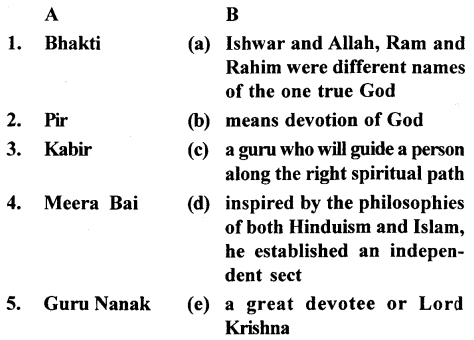
B. Match the following :
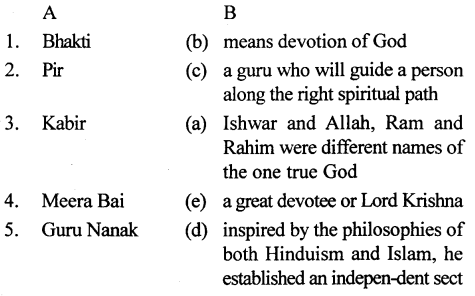
The Trail History and Civics for Class 7 ICSE Solutions Chapter 11 Bhakti and Sufi Movements 1
Answer:
The Trail History and Civics for Class 7 ICSE Solutions Chapter 11 Bhakti and Sufi Movements 2

C. Choose the correct answer :

1. The Sufis were a group of Hindu/Buddhist/Muslim mystics.
Ans. The Sufis were a group of Muslim mystics.

2. The word ‘bhakti’ means fear of God/following rituals/ devotion to God.
Ans. The word ‘bhakti’ means devotion to God.

3. The Bhakti saints drew their inspiration from the Bhagwad Gita and the Vedas/Puranas/Upanishads.
Ans. The Bhakti saints drew their inspiration from the Bhagwad Gita and the Upanishads.

4. Guru Nanak/Guru Tegh Bahadur/Guru Gobind Singh was the founder of the Sikh religion.
Ans. Guru Nanak was the founder of the Sikh religion.

5. The word ‘Sikh’ is derived from a word which means teacher/disciple/warrior.
Ans. The word ‘ Sikh’ is derived from a word which means disciple.

D. State whether the following are true or false :

1. The organization of the Sufis was known as the sangha.
Ans. False.
Correct : The organization of the Sufis was known as the silsilas.

2. Bhakti saints believed in monotheism.
Ans. True.

3. Ramananda taught his message through dohas.
Ans. False.
Correct : Kabir taught his message through dohas.

4. Chaitanya Mahaprabhu was a believer in the importance of following rituals.
Ans. False.
Correct : Chaitanya Mahaprabhu was a believer in the existence of God.

5. Guru Tegh Bahadur was executed by Aurangzeb.
Ans. True.

E. Answer the following questions in one or two words/ sentences :

Question 1.
Who were the Sufis?
Answer:
The Sufis were a group of Muslim mystics who started a religious reform movement in West Asia.

Question 2.
What are silsilas?
Answer:
Silsilas were the monsastic organizations of the Buddhist sangha and the Sufis.

Question 3.
Name the two popular Sufi orders in India.
Answer:
Chishti and the Suhrawardi orders, became popular in India.

Question 4.
What is the importance of qawwali in Sufism?
Answer:
One could come closer to God through devotional music qawwali.

Question 5.
Mention any one positive effect of the Bhakti Movement on Hindu-Muslim unity.
Answer:
People were attracted to the principles of monotheism, equality and ritual-free worship. By propagating its principles of one God, universal brotherhood and respect for all religions, the Bhakti Movement created conditions conducive to the harmonious and peaceful coexistence of Hindus and Muslims.

Question 6.
What are dohas?
Answer:
Dohas were the simple, beautiful Hindi verses (poems) through which Kabir spread his message.

Question 7.
How did Meera Bai spread the message of Bhakti among the people.
Answer:
Meera Bai spread the message of devotion and love for God through devotional songs called Meera’s bhajans.

Question 8.
Name the five sacred symbols of Sikhism.
Answer:
The five sacred symbols of Sikhism are :

(a) Kesh
(b) Kanga
(c) Kaccha
(d) Kirpan
(e) Kara

Question 9.
Who transformed the Sikhs into a martial race?
Answer:
Guru Gobind Singh transformed the peace-loving Sikhs into a martial race.

Question 10.
How did the Sufi and Bhakti movements lead to the development of local languages?
Answer:
The Bhakti and Sufi saints preached in the language of the common people and this led to the development of local language.

F. Answer the following questions briefly :

Question 1.
What are the important teachings of the Sufi saints? Explain the impact of Sufism on the people and their rulers?
Answer:
Teachings of Sufism :

(a) There is only one god and all people are his children.
(b) All human beings are equal.
(c) Different religions are different paths leading to one God. Therefore, all religions must be respected.
(d) It is necessary to follow the path shown by a pir, who will guide a person along the right spiritual path.

The liberal ideas and rational principles of sufism, had great impact on the people and their rulers. It encouraged religious tolerance promoted the idea of universal brotherhood and brought the Hindus and Muslims closer to one another.

Question 2.
Explain the origin of the Bhakti Movement in India. Why did the teaching of the Bhakti saints appeal to the people?
Answer:
The word ‘bhakti’ means devotion to God. The Bhakti Movement was a reform movement within Hinduism. It began in South India in the 7th century CE and became a popular movement before the arrival of the Turks. The Bhakti saints drew their inspiration from the Upanishads and the Bhagavad Gita. People were attracted to the principles of monotheism, equality and ritual-free worship. By propagating its principles of one God, universal brotherhood and respect for all religions, the Bhakti Movement created conditions conducive to the harmonious and peaceful coexistence of Hindus and Muslims.

Teachings of the Bhakti saints :

(a) There is only one God. Everyone is equal in the eyes of God.
(b) God can be reached through love and devotion and total surrender to his will and not through rites rituals and idol worship.
(c) Everyone should lead a pure life.

Question 3.
Mention the chief teachings of the Bhakti saints.
Answer:
Teachings of the Bhakti saints:

(a) There is only one God. Everyone is equal in the eyes of God.
(b) God can be reached through love and devotion and total surrender to his will and not through rites rituals and idol worship.
(c) Everyone should lead a pure life.

Question 4.
Mention the important teachings of Sant Kabir.
Answer:
Sant Kabir stressed the idea of one God. He taught that Ishwar, Allah, Ram and Rahim were different names of one God. He spread the message of Hindu-Muslim unity, Universal brotherhood, tolerance and banned idol worship, caste system and rituals. Kabir preached his message through simple beautiful Hindi poems called Dohas.

Question 5.
What are the main teachings of Guru Nanak? Why is the holy book of the Sikhs known as the Guru Granth Sab ib?
Answer:
The important teachings of Guru Nanak are as follows :

(a) There is only one God and He is the creator of this universe.
(b) All human beings are equal. The caste system must be rejected and the principle of universal brotherhood must be followed.
(c) Everyone should lead a good and pure life based on truth and kindness, and discard idol worship and ritualism.
(d) True spiritual knowledge can be gained under the guidance of a guru.

The last Guru Gobind Singh Ji, transferred the authority of the Guru to the holy scriptures called the ‘Adi Granth’ which came to be known as the Guru Granth Sahib. The teachings of all the Gurus are contained in it and it serves as a guide or Guru.

Question 6.
What effect did the Bhakti and Sufi movements have on Indian society?
Answer:
The Bhakti and Sufi movements brought a new era in Indian society which was based on tolerance and brotherhood among the human beings. Following are the impact of the movements :

(a) The Bhakti and Sufi movement preached in the language of the common man which gave rise to development of common languages.
(b) The common man came to know about great truths of Hindu philosophy which helped in slowing down conversions during this period.
(c) These movements helped in reducing the superiority of the brahmanas.
(d) They also brought feeling of universal brotherhood and created an environment of tolerance and mutual respect.

G Picture study :
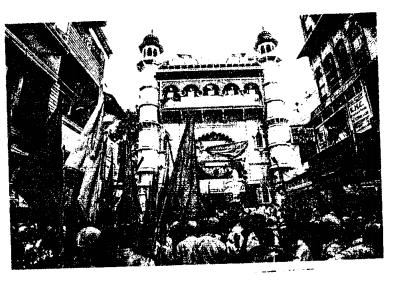
This is the picture of a monument associated with the founder of a religious reform movement in India. (Picture on next page)

Question 1.
Name the reformer and the movement he started in India.
Answer:
Religious reformer was Moinuddin Chishti. He started Sufi- Movements.

Question 2.
Identify the monument.
Answer:
Dargah of Moinuddin Chisti.

The Trail History and Civics for Class 7 ICSE Solutions Chapter 11 Bhakti and Sufi Movements 3

Question 3.
Why is this monument famous?
Answer:
This monument is famous for its teachings

(a) All human beings are equal and God is only one.
(b) All religions must be respected.
(c) Fasts and other rituals are not necessary.
(d) There is no need to convert to another religion.

Question 4.
Mention any four important religious principles of that movement, which are common to the principles of the Bhakti Movement.
Answer:

(a) There is only one God.
(b) Everyone is equal in the eyes of God.
(c) God can be reached through love and devotion and total surrender to His will and not through rites, rituals and idol worship.
(d) Eveyone should lead a pure life.

Question 5.
Name any two religious reformers of the Bhakti Movement.
Answer:
Ramananda, Guru Nanak Dev ji.

OTHER IMPORTANT QUESTIONS

Question 1.
Why was the Bhakti movement revived and strengthened in the Medieval Period?
Answer:
The Bhakti movement revived and strengthened during the Medieval Period as people got attracted to the principles of equality, one God, universal brotherhood and respect for all religions. This movements provided conducive conditions for peaceful and harmonious co-existence of the Hindus and Muslims.

Question 2.
What are the main principles of Sikhism?
Answer:
The main principles of Sikhism are :

(a) There is only one God and he is the creator of this universe.
(b) All human beings are equal. The caste system must be rejected and the principles of universal brotherhood must be followed.
(c) Everyone should lead a good and pure life based on truth and kindness, and discard idol worship-and ritualism.
(d) True spiritual knowledge can be gained under the guidance of a guru.

Question 3.
Why is the Sikh religion also referred to as Gurumat?
Answer:
In Sikh religion Guru acquires the central position. The word sikhis derived from a word which means disciple, so Sikhism is also referred to as Gurumat means guru’s doctrine.

Question 4.
What provoked Guru Govind Singh to infuse his followers with the martial spirit?
Answer:
To save the people from cruelty of Mughal rulers, Guru Govind Singh infused his followers with the martial spirit.

Question 5.
Throw some light on how the Sufis came to India?
Answer:
The Sufis came to India with the Turks in the 12th century. As the course of time went on, they absorbed Buddhist and Hindu influences and were greatly respected by the Muslims as well as the Hindus.

Question 6.
Who was the founder of the Sufi movement in India?
Answer:
The founder of the Sufi movement in India was Moinuddin Chisti. His dargah in Ajmer is an important pilgrimage centre for both the Muslims and the Hindus.

The Trail History and Civics for Class 7 ICSE Solutions – Jahangir, Shah Jahan, Aurangzeb

The Trail History and Civics for Class 7 ICSE Solutions – Jahangir, Shah Jahan, Aurangzeb

ICSE SolutionsSelina ICSE SolutionsML Aggarwal Solutions

Trail HistoryCivics Focus on HistoryCivicsGeographyMathsPhysicsChemistryBiology

EXERCISE

A. Fill in the blanks :

  1. Nur Jahan became the virtual ruler of the Mughal empire.
  2. During the final years of Jahangir’s reign, there was a power struggle between Nur Jahan and Shah Jahan.
  3. Shah Jahan’s reign is often referred to as the Golden Age of the Mughal empire.
  4. Aurangzeb spent the first half of his reign in the North and the second half in the Deccan.
  5. Aurangzeb spent the last twenty six years of his reign fighting against the Marathas and the Sultanates of Bijapur and Golconda.

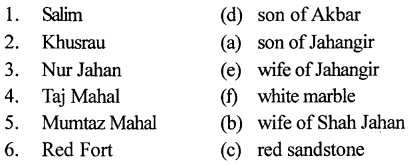
B. Match the following :
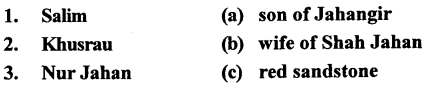
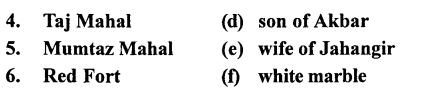
The Trail History and Civics for Class 7 ICSE Solutions Chapter 10 Jahangir, Shah Jahan, Aurangzeb 1
The Trail History and Civics for Class 7 ICSE Solutions Chapter 10 Jahangir, Shah Jahan, Aurangzeb 2
Answer:
The Trail History and Civics for Class 7 ICSE Solutions Chapter 10 Jahangir, Shah Jahan, Aurangzeb 3

C. Choose the correct answer :

1. The foundations laid by Akbar/Babur/Humayun were so strong that Jahangir did not have any major problems maintaining the empire.
Ans. The foundations laid by Akbar were so strong that Jahangir did not have any major problems maintaining the empire.

2. Shah Jahan built the magnificent Agra Fort/Taj Mahal/ Red Fort in the memory of his wife Mumtaz Mahal.
Ans. Shah Jahan built the magnificent Taj Mahal in the memory of his wife Mumtaz Mahal.

3. Shah Jahan built a new city called Fatehpur Sikri/ Daulatabad/Shahjahanabad.
Ans. Shah Jahan built a new city called Shahjahanabad.

4. Aurangzeb’s reign can be roughly divided into four/ three/two periods.
Ans. Aurangzeb’s reign can be roughly divided into two periods.

5. One of the most serious challenges faced by Aurangzeb came from the Sikhs/Marathas/Rajputs in the Deccan.
Ans. One of the most serious challenges faced by Aurangzeb came from the Marathas in the Deccan.

D. State whether the following are true or false :

1. Jahangir defeated the Rana of Mewar.
Ans. True.

2. Jahangir is said to have installed a chain of justice.
Ans. True.

3. The Peacock Throne was taken to Persia by Nadir Shah.
Ans. True.

4. The Jama Masjid is said to be the most perfect of Jahangir’s buildings.
Ans. False.
Correct : The Jama Masjid is said to be the most perfect of Shah Jahan’s buildings.

E. Answer the following questions in one or two words/ sentences :

Question 1.
Why did Jahangir not face any major problems in maintaining his large empire?
Answer:
The foundations laid by Akbar were so strong that Jahangir did not have any major problems maintaining the empire.

Question 2.
Name Jahangir’s son who rebelled against him.
Answer:
The rebellion of his eldest son, Khusrau.

Question 3.
Why is Shah Jahan known as the Engineer King?
Answer:
Shah Jahan is known as Engineer King due to his work in the field of architecture. During his time magnificent buildings were constructed which are remembered still now. Some of the finest examples of monuments during his reign are — the magnificent Taj Mahal at Agra, the Moti Masjid at Agra Fort and the dignified Jama Masjid at Delhi.

Question 4.
Which fort did Shah Jahan build in the new city of Shahjahanabad?
Answer:
Red Fort.

Question 5.
Who succeeded Shah Jahan as the Mughal emperor?
Answer:
Shah Jahan’s third son, Aurangzeb.

Question 6.
State any one major cause of the decline of the Mughal empire.
Answer:
He spent too much money on militaiy expeditions and building magnificent monuments which drained the royal treasury.

Question 7.
What was the nature of Aurangzeb’s Rajput policy in the early years of his reign?
Answer:
During the early years of his reign, Aurangzeb followed Akbar’s policy of friendship with the Rajputs. He granted the Rajput rulers high mansabs and tried to win their support.

Question 8.
What were the objectives of Aurangzeb’s Deccan policy?
Answer:
Aurangzeb wanted to crush the growing powers of the Maratha’s. As these people were very strong and courageous and they also did not accept the overlordship of the ruler. This empire was also very vast and prosperous, so Aurangzeb wanted to have it under his control.

Question 9.
Why did the annexation of Bijapur and Golconda prove harmful for the Mughal empire?
Answer:
It became too vast and unwieldy and brought the Mughals into direct contact with the Marathas.

F. Answer the following questions briefly :

Question 1.
Jahangir fulfilled Akbar’s unrealized imperial dreams by conquering Mewar. Explain.
Answer:
Jahangir sent an expedition against RanaAmar Singh of Mewar who, like his father, Rana Pratap Singh, had refused to acknowledge the overlordship of the Mughal emperor. The Rana of Mewar was defeated. He pledged his loyalty to Jahangir, who treated him with courtesy. He allowed the Rana to retain his territory and appointed his son, Kama, as a military commander in the imperial army. The submission of Mewar established the paramountcy of Mughal authority in Rajputana and marked the fall of the last bastion of Rajput resistance.

Question 2.
To what extent were Jahangir’s Deccan campaigns successful?
Answer:
Jahangir sent an expedition under Prince Khurram who managed to recapture the fort of Ahmadnagar. Prince Khurram was honoured with the title of Shah Jalian (Lord of the World). The war continued and by the end of Jahangir’s reign, Ahmadnagar reasserted its independence and remained outside Mughal control.

Question 3.
What qualities did Nur Jahan possess to make her worthy of her name?
Answer:
Nur Jahan means-light of the world and according to her name she possessed all the qualities like she was intelligent, beautiful, educated and cultured. She was a good poet and designer too. She designed new varieties of fabrics and jewellery. She was also strong and courageous and helped Jahangir to take decisions in matters related to the government.

Question 4.
Nur Jahan was very ambitious and eventually became the power behind the throne. Explain.
Answer:
Nur Jahan was ambitious and soon became the power behind the throne. Jahangir consulted her on all matters concerning the affairs of the government. Nur Jahan soon became the virtual ruler of the Mughal empire. Graudally, Jahangir left the administration in her hands and spent his time indulging in his addiction to wine and opium. Coins began to be issued jointly in the name of Jahangir and Nur Jahan.
Nur Jahan used her positioin and influence to appoint her father, brother and other relatives to important posts in the administration. Her niece, Mumtaz Mahal, was married to Jahangir’s third son, Khurram (Shah Jahan).

Question 5.
Shah Jahan’s reign was an age of splendour and cultural brilliance. In this context, discuss:

(a) Taj Mahal
(b) Red Fort

Answer:

(a) Taj Mahal : It took more than 20 years to complete the Taj Mahal, at a cost of one crore rupees at that time. It is made of pure white marble and is lavishly decorated with semi-precious stones and lace-like screens. It is an octagonal monument with a splendid dome and four slender minerals, set in a beautiful garden,
(b) Red Fort : This building is made of red sandstone. There are many splendid buildings inside the Red Fort. The Diwan-i-Khas is the most impressive. Its ceiling is made of silver. Its walls are made of marble and decorated with gold and semi-precious stones.

Question 6.
Why did Aurangzeb’s Deccan campaign against the Marathas prove to be a ruinous misadventure? What were the long-term consequences of this campaign?
Answer:
The Deccan campaign proved to be a ruinous misadventure that showed lack of political wisdom.
Suspicious by nature, he did not trust his sons and nobles. His officials were like puppets on strings. Aurangzeb’s supervision of every department often bordered on interference.
His policy of discrimination between his subjects on grounds of faith also made him unpopular. He was a man of unshakeable convictions and tried very hard to reach his goals by doing what he thought was right. As he lay on his deathbed, he wrote several letters to his son. In one letter he wrote, ‘I know not who I am or why I came into the world … I have not done well for the country or its people … I know what punishment will be in store for me to suffer.’ During the first half of the 19th century CE, the great Mughal empire decayed and disintegrated. The Mughal emperors lost their power and glory and their vast empire finally shrank to a few square miles around Delhi.

Question 7.
Why did Aurangzeb fail as a ruler?
Answer:
Aurangzeb possessed qualities of an ideal man but he was failure as a ruler. Like his father he was not able to follow the policy of religious tolerance and friendship. His list of enemies not only included Rajput’s but also Sikhs and the Marathas. He was also very suspicious by nature, which was not liked by his officials. His policy of discrimination with his subjects also made him an unpopular ruler.

Question 8.
Briefly explain the negative aspects of Shah Jahan’s reign that eventually led to the decline of the Mughal empire.
Answer:
Hie policy of religious tolerance and friendship with the Rajputs was continued by Shah Jahan.
Behind the glamour and the glitter of Shah Jahan’s reign, however, lurked some disturbing shadows.

  1. Shah Jahan’s military expeditions to Central Asia and Kandahar and the extravagant building projects drained the royal treasury.
  2. To improve the country’s financial resources, heavier taxes where imposed on the peasantry.
  3. According to Bernier, the French traveller, many villages were mined and left desolate. This setback to agriculture became a major cause of the decline of the Mughal empire.
  4. The failure of military campaigns during this period was an indication of the decline of the military might of the Mughals.
  5. The administrative machinery had grown in size but corruption had crept in.

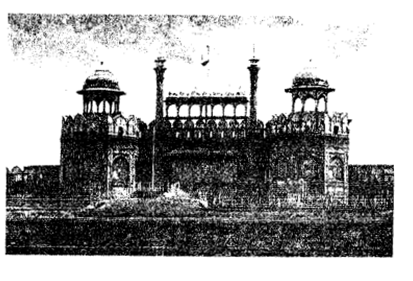
G Picture study :
This is a picture of a 17th century-CE. monument, built in red sandstone by a Mughal emperor.

The Trail History and Civics for Class 7 ICSE Solutions Chapter 10 Jahangir, Shah Jahan, Aurangzeb 4

Question 1.
Identify the monument.
Answer:
Red Fort.

Question 2.
Where is it located?
Answer:
Old Delhi.

Question 3.
Who built this monuments?
Answer:
ShahJahan.

Question 4.
Name two important buildings inside this monument.
Answer:

(a) Diwan-i-Khas
(b) Diwan-i-Aam

Question 5.
Mention its important features.
Answer:
Important features are as :
The Diwan-i-Khas is the most impressive. Its ceiling is made of silver and its walls are made of marble decorated with gold and semi-precious stones.
Diwan-i-Aam was Shah Jahan’s Peacock Throne. It had a canopy supported by twelve emerald pillars, each bearing two peacocks studded with gems. This golden throne, which took 7 years to complete, was taken to Persia by Nadir Shah in 1739 CE.

OTHER IMPORTANT QUESTIONS

Question 1.
What role did Nur Jahan play in the administrative affairs of the empire?
Answer:
Nur Jahan was the power behind the throne. Jahangir consulted her on all the matters related to the administration. Slowly she became the virtual ruler of the empire.

Question 2.
How did Aurangzeb come to power?
Answer:
Aurangzeb with the help of his brother Murad defeated Dara and executed him. Then he imprisoned his father in the Agra Fort and occupied the throne.

Question 3.
When and where Jahangir give permission to set up trading posts to English East India Company?
Answer:
Jahangir gave permission to English East India company to set up trading posts in AD 1618 at Surat and Broach.

Question 4.
Give reason to show Jahangir was a great lover of justice?
Answer:
Jahangir was a great ruler who was always concerned about the welfare of his people and did his best to provide them justice. For this he had installed a ‘chain of justice’ made of pure gold with sixty bells attached to it, between his palace and the bank of the Yamuna. Anybody could ring that bell and ask for justice and Jahangir would personally listen to the complaints and gave solution for it.

The Trail History and Civics for Class 7 ICSE Solutions – Akbar

The Trail History and Civics for Class 7 ICSE Solutions – Akbar

ICSE SolutionsSelina ICSE SolutionsML Aggarwal Solutions

Trail HistoryCivics Focus on HistoryCivicsGeographyMathsPhysicsChemistryBiology

EXERCISE

A. Fill in the blanks :

  1. In the Second Battle of Panipat which took place in November 1556, the Mughal army under the leadership of Bairam Khan defeated General Hemu.
  2. Akbar held regular meetings with his senior officers in the Diwan-i-Khas and he met his subjects in the Diwan-i-Aam.
  3. The Mughal empire was divided into fifteen provinces and subas which were further subdivided into districts or Sarkars.
  4. The land revenue system introduced by Akbar was known as the Toda Mai’s Bandobast system.
  5. The minimum age of marriage was raised to fourteen years for girls and sixteen years for boys.
  6. Two great poets patronized by Akbar were Faizi and Raja Birbal

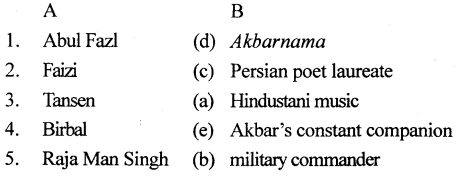
B. Match the following :
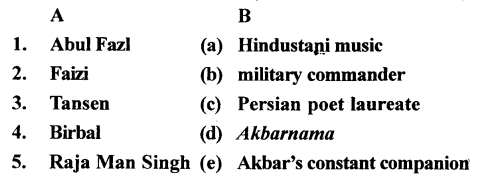
The Trail History and Civics for Class 7 ICSE Solutions Chapter 9 Akbar 1
Answer:
The Trail History and Civics for Class 7 ICSE Solutions Chapter 9 Akbar 2

C. Choose the correct answer :

1. Akbar was 13/15/17 years old when he was proclaimed emperor.
Ans. Akbar was 13 years old when he was proclaimed emperor.

2. Rana Udai Singh/Jai Mal/Rana Pratap Singh was defeated by the Mughal forces in the Battle of Haldighati.
Ans. Rana Pratap Singh was defeated by the Mughal forces in the Battle of Haldighati.

3. In 1575 CE, Akbar built the Ibadat Khana in his new capital for discussions on politics/religious/warfare.
Ans. In 1575 CE, Akbar built the Ibadat Khana in his new capital for discussions on religious.

4. Akbar founded a new religious order which he called Din -i-Ilahi/Mahzar/Sulh-i-kul.
Ans. Akbar founded a new religious order which he called Din- i-Ilahi.

5. The court language used in Akbar’s court was Turkish/ Persian/Sanskrit.
Ans. The court language used in Akbar’s court was Persian.

D. State whether the following are true or false:

1. Akbar assumed absolute power and authority at the age of 21.
Ans. False.
Correct: Akbar assumed absolute power and authority at the age of 18.

2. Akbar held regular meetings with the senior officers in the Diwan-i-Khas.
Ans. True.

3. In each suba, the diwan kept records of the land revenue.
Ans. True.

4. Din-i-Ilahi was adopted by all the people in Akbar’s empire.
Ans. False.
Correct : Din-i-Ilahi was introduced by all the people in Akbar’s empire.

5. Akbar was illiterate but he had a passion for books.
Ans. True.

E. Answer the following questions in one or two words/ sentences :

Question 1.
What role did Bairam Khan play when Akbar ascended the throne?
Answer:
Bairam Khan managed the affairs of the state on behalf of Akbar.

Question 2.
What is the significance of the Second Battle of Panipat (1556 CE)?
Answer:
In the second battle of Panipat, Akbar’s army under the leadership of Bairam Khan defeated and skilled Hemu, the general’of Adil Shah who had occupied the city of Delhi. Due to this battle, the Afghan power was crushed and Akbar’s throne became safe from enemies.

Question 3.
Why did Akbar embark on a policy of conquest and annexation?
Answer:
Akbar embarked on a policy of conquest and annexation. His aim was to bring the entire country under his control.

Question 4.
Why did Akbar follow a policy of friendship with the Rajput?
Answer:
Akbar realized that Delhi and Agra could never be safe until the Rajputs were subdued. He also realized that the friendship and support of the Rajputs would be of great help in strengthening and expanding the Mughal empire.

Question 5.
Why is the memory of Rana Pratap Singh still honoured in Rajasthan?
Answer:
People in Rajasthan still honour the memory of Rana Pratap Singh because his whole life he fought for throwing the Mughal’s out of their territory.

Question 6.
What do you understand by the term ‘mansab’?
Answer:
The term ‘mansab’ means office or rank.

Question 7.
Who had the power to appoint and dismiss the mansabdars?
Answer:
The mansabdars were appointed, promoted or dismissed by the emperor.

Question 8.
Mention any one tax abolished by Akbar as a part of his policy of religious tolerance.
Answer:
Akbar abolished the jaziya (poll) tax and the pilgrim tax.

Question 9.
What power did Akbar gain through the Mahzar?
Answer:
Akbar issued a declaration called Mahzar, which gave him the power to choose between different interpretations of Islamic law.

Question 10.
Why did Akbar encourage the study of secular subjects?
Answer:
Akbar encourage the study of secular subjects like Mathematics, Agriculture, Logic, History and Astronomy to increase the knowledge of people and to promote religious harmony.

F. Answer the following questions briefly :

Question 1.
Why was Akbar’s position unstable and insecure when he ascended the throne of Delhi?
Answer:
Akbar’s position was unstable and insecure, when he ascended the throne of Delhi because his empire was surrounded by enemies on all the sides. Adil Shah who was the nephew of Sher Shah was determined to capture Delhi and re-establish the Afghan rule. Even the Rajputs were waiting for suitable opportunity to throw the Mughals out of India.

Question 2.
Rana Udai Singh of Mewar rejected Akbar’s offer of friendship and refused to submit to him. In this context, discuss :

(a) Subjugation of Rana Udai Singh
(b) Conflict with Rana Pratap Singh

Answer:
(a) The Rana of Mewar was considered to be the head of the Rajput clans. He refused to submit to Akbar and rejected his proposal of a matrimonial alliance. Akbar marched against Chittor, the capital city of Mewar. Udai Singh escaped to the hills, leaving the defence of Chittor to Jai Mai, the commander of the Rajput forces. For 4 months, the Mughal army tried in vain to capture the fort of Chittor.
Resistance collapsed when Jai Mai was killed. All the Rajput women performed jauhar. The heroic Rajputs rushed out in a desperate bid to destroy the enemy. They perished fighting.
The capture of Chittor was followed by the fall of Ranthambore. By 1570 CE, practically all the Rajput princes had accepted Akbar as their overlord.
(b) The Rajputs of Mewar, however, refused to submit. Having lost Chittor, their capital city, they rallied around Rana Pratap, the valiant son of Udai Singh. After his escape to the hills, Udai Singh had built a new capital called Udaipur.
After Udai Singh’s death, Rana Pratap carried on the struggle against the Mughals. With a great deal of difficulty, Rana Pratap organized and army and clashed with the Mughal forces in the Battle of Haldighati 1576 CE. The Mughal forces were led by the Rajput chief, Raja Man Singh of Amber.
The Rajputs were outnumbered and defeated by the Mughal army. Rana Pratap took shelter in a mountain fortress and continued his efforts to recover Chittor. He was able to recover parts of his territories before his death, but not Chittor.

Question 3.
Discuss the power and position of the emperor in the central administration.
Answer:

  1. The emperor was an extremely powerful figure. His decisions on all matter-military, political, administrative and judicial-were final. His word was law. He was the commander-in-chief of the armed forces and the supreme ‘ judge on all matters of justice.
  2. He was assisted by a team of ministers and officials. The appointment, promotion and dismissal of all officials,including commanders of the army, was the sole right of the emperor. The success of this system depended largely on the personality of the emperor and his wisdom to choose the right person for the right job.

Question 4.
Who assisted the emperoi\in the administration of the empire? What were their responsibilities and functions?
Answer:
The emperor was assisted by a team of ministers and officials for proper administration of the empire. Their names and functions are as follows :

  1. Wazir Dewan : He was the head of the revenue department.
  2. Mir Bakshi : He was the head of the military department and the paymaster of all mansabdars.
  3. The Qazi : He was the chief judge.
  4. Chief Sadr : He was the supervisor of the royal household.
  5. Vakil : He was the head of the advisory board.

Question 5.
Explain any five main features of the mansabdari system introduced by Akbar.
Answer:
Under this system, every official was given a rank or a mansab. The rank depended on the nature and importance of the job. The lowest rank was that of an officer in charge of ten horsemen, while the highest mansab was that of an officer maintaining 7,000 horseman. The mansab’s were given salary in accordance with their rank. They were usually paid in the form of jagirs.

Question 6.
What measures did Akbar adopt to reorganize and strengthen the army?
Answer:

  1. Every official in the imperial service was given a rank or a mansab. The rank depended on the nature and importance of the job. The lowest rank was that of an officer in charge of ten horsemen, while the highest mansab was that of an officer maintaining 7,000 horseman. The higher mansabs were reserved for the members of the royal family.
  2. The mansabdars were appointed, promoted or dismissed by the emperor.
  3. They were given a salary in accordance with their rank. Later, they began to be paid in the form of jagirs. They were entitled to a fixed amount of revenue from the jagir as salaiy for themselves and their troops.
  4. A mansab or rank was not hereditary. After the death of the mansabdar, the jagir reverted to the king, who granted it to someone else.
  5. The mansabdars did not have any authority or responsibility of administering the jagir.
  6. The system of branding horses and maintaining a descriptive roll of the soldiers was adopted by Akbar.
  7. Akbar also maintained a standing army. The cavalry was the most important branch of the Mughal army. The troops were mainly supplied by the mansabdars. The emperor also directly recruited and maintained a battalion of loyal and trusted soldiers. He maintained a corps of royal bodyguards and armed palace guards, a large number of war elephants and a well-organized artillery.

Question 7.
Explain the important features of the land revenue system introduced by Todar Mai.
Answer:
Todar Mai introduced a land revenue system known as Todar Mai’s Bandobast.

  1. Land was surveyed and measured with a bamboo jarib joined together with iron rings instead of the hemp rope used earlier.
  2. The land was grouped into four categories depending on whether it was regularly or occasionally cultivated. It was classified further into good, middling and bad categories.
  3. The average produce and the average price over the past 10 years were calculated. The revenue was calculated on the basis of these averages. One third of the average produce was the king’s share. It could be paid in cash or kind, though cash was preferred.
  4. The revenue officers were instructed to treat the peasants well.
  5. Loans which could be paid back in easy instalments were advanced to the peasants to buy seeds, cattle and implements.
  6. If the crops failed due to drought or flood, the state granted remission of revenue.

Question 8.
What policies did Akbar follow to transform the Islamic state into a secular one and unite the diverse races in the country into a single nation based on equality?
Answer:
Akbar took following steps to transform the Islamic state into a secular one and unite the diverse races in the country into a single nation based on equality :

  1. He abolished the Jaziya tax which was imposed by earlier Muslim rulers on all non-Muslim subjects and pilgrim tax imposed on Hindus visiting places of pilgrimage.
  2. He allowed Hindus to build temples, celebrate festivals and worship freely. He even allowed his Hindu wives to celebrate festivals like Holi and Diwali.
  3. He gave high posts to talented and competent Hindus in his court, examples are : Todar Mal, Birbal and Raja Bhagwan Das.
  4. He married Rajput princesses and allowed them freedom of worship.
  5. He granted land to all persons irrespective of their religious faith

Question 9.
Briefly explain the features and objectives of the Din- i-Ilahi?
Answer:
Akbar formed a new religious order which was called Din- i-Ilahi or divine faith. The main features of this religion were belief in one God and recognition of the emperor as God’s representative on earth. Din-i-Ilahi was more like a code of conduct and there was no sacred books, no priestly classes, no places of worship and no rituals in it.
The main objective of establishing it was to provide a religious order which would be acceptable to the Hindu, Muslims and other communities and to promote universal brotherhood and national unity.

Question 10.
Mention the important features of Akbar’s Rajput policy. Why did he adopt this policy and what were its results?
Answer:
Akbar realized that the support of the Rajputs was necessary to build a powerful empire. For this he adopted the following policy :

  1. Akbar treated the Rajputs with honour and equality and won their respect and loyalty.
  2. He married Rajput princesses to strengthen his ties with Rajputs.
  3. He appointed Rajputs on High posts in his court to win their friendship, loyalty and cooperation.
  4. He abolished the Jaziya and pilgrim tax levied on Hindus.
  5. Akbar did not annexed the kingdoms of the Rajput rulers but only asked them to recognize him as their overlord and pay him regular tribute. The result of adopting this policy was that Akbar won the loyalty and support of the Rajputs, Who formed the backbone of a strong and stable empire.

Question 11.
Mention any two important social reforms introduced by Akbar?
Answer:
Akbar introduced a number of social reforms to rid Indian society from some cruel practices like :

  1. He abolished the sati pratha and legalized remarriage of widows.
  2. He discouraged child marriage. He raised the minimum age of marriage of girls to fourteen years and of boys to sixteen years.

Question 12.
Give an account of Akbar’s cultural achievements with reference to :

(a) Literature
(b) Architecture

Answer:
(a) Abul Fazl was Akbar’s court historian. He wrote the Akbarnama, which is an excellent historical work in Persian.Hindi was also used in the Mughal court. Raja Birbal was made the Hindi Kavi Raj or poet laureate in Akbar’s court. The Ramacharitamanas was written by Tulsidas, the greatest Hindi author in those tunes.
(b) Initially, the style of architecture was Persian, for instance. Humayun’s Tomb. However, with the passage of time. Akbar’s architectural style became more and more Indian. Inspired by the palaces of Hindu rajas. Akbar’s later buildings reflect Rajput traditions.
Fatehpur Sikri. Akbar’s new capital city, contains many interesting Rajput-style buildings made of sandstone. It is referred to as a dream in stone. Among the many fine buildings are the Diwan-i-Khas. Panch Mahal. Jodha Bai’s Palace and the Buland Darwaza.

G Picture study :
The picture depicts a Mughal emperor holding discussions on religious matters in the Ibadat Khana.
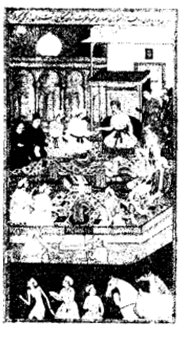
The Trail History and Civics for Class 7 ICSE Solutions Chapter 9 Akbar 3

Question 1.
Identify the emperor.
Answer:
Akbar.

Question 2.
Which religious communities participated in the discussions?
Answer:
Muslim clerics, Hindu scholars. Buddhist and Jain monks. Parsi priests. Christian missionaries, etc. assembled in the Ibadat Khanna.

Question 3.
Why did the emperor organize these assemblies?
Answer:
The Emperor organize these assemblies to explain the principles and teachings of all the religion.

OTHER IMPORTANT QUESTIONS

Question 1.
Why did Akbar introduce the policy of establishing matrimonial alliances with the Rajputs?
Answer:
Having understood the advantages of a friendly relationship with the Rajputs to acquire more power and kingdoms, he introduced the policy of establishing matrimonial alliances with them.

Question 2.
Why did Akbar conquer Gujarat and Bengal?
Answer:

  • Gujarat : Akbar conquered Gujarat because it was a rich province with fertile cotton fields, flourishing seaports and good trade market.
  • Bengal : He also set his eyes on Bengal because it was also one of the most fertile and richest provinces in India. It had also good trade links with other countries.

Question 3.
What was the position of the emperor in the administrative set-up?
Answer:
The emperor enjoyed extreme powers. His decisions on all matters like military, political, administrative and judicial were final. His word was law. He was the commander-in-chief of the armed forces and the supreme judge on all matter of justice.

Question 4.
How was a uniform system of administration maintained throughout the empire?
Answer:
The big empire was divided into fifteen provinces or subas. A governor or subedar was in charge of each province. The subedar had control over both military and civil affairs. The provinces were subdivided into districts or Sarkars, which were further subdivided into smaller units of administration called parganas. Each of these units had a team of government officials to manage all the affairs and the villages were managed by the village panchayats.

Question 5.
What happened to a mansabdar’s jagir after his death?
Answer:
The mansabdari system was not hereditary. After the death of the mansabdar his jagir came back to the king, who granted it to someone else.

Question 6.
Discuss Akbar’s revenue system with reference to :

  1. Survey and assessment of land
  2. Revenue calculation
  3. Relief measures

Answer:

  1. Survey and assessment of land : The land was surveyed and measured with a bamboo jarib joined together with iron rings. The land was grouped into four categories depending on whether it was regularly or occasionally cultivated. It was further classified into good, middle and bad categories.
  2. Revenue calculation : Revenue was calculated on the basis of average produce and average price of the past ten years. One third of the average produce was the king’s share.
  3. Relief measures : Many relief measures were adopted by the state like loans were granted to peasants which could be paid back in easy instalments and if the crops failed due to drought or flood the state even granted remission of revenue.

Question 7.
How did the revenue system benefit the state and the farmers?
Answer:
The revenue system benefited both the state and the farmers. This system provided the state with a fixed and steady source of income whereas to farmers it helped in many ways like the farmers were able to get loan on easy instalments for buying seeds, cattle and implements. The calculation of revenue was also based on the type of land i.e. good, bad or middle. If the crops of the farmers failed due to drought or flood the revenue was also remitted by the state.

Question 8.
Why did Akbar build the Ibadat Khana?
Answer:
Akbar built Ibadat Khana at Fatehpur Sikri for discussions on religious matters. Scholars, philosophers, priests, missionaries and religious leaders were invited here to hold discussions. These Dignities assembled in the Ibadat Khana and explained the principles and teachings of their respective religions.